10 Transformer Buying Tips for Global Buyers?
Buying a power transformer across borders is not simply a matter of comparing prices. It is a decision about safety, uptime, compliance, and long-term operating cost. A unit that looks suitable on paper may fail when local humidity, altitude, grid instability, or installation space is considered. Global buyers need clearer questions before signing a purchase order.
Transformer engineer and author Martin J. Heathcote has stressed a practical principle: “The transformer must be matched to its application, not merely to its rating.” This idea remains highly relevant for every Transformer Transformer project. Buyers should examine voltage ratios, frequency, vector group, impedance, cooling method, insulation level, tap-changer design, and expected load growth. Small details matter. A 10 kV difference can affect protection settings, cable selection, and commissioning results.
This guide presents ten buying tips for international procurement teams, electrical contractors, and plant owners. It addresses technical specifications, factory testing, documentation, certification, packaging, delivery terms, spare parts, and after-sales support. It also considers questions that are often missed, such as oil quality, noise limits, corrosion protection, and service response time.
Experience changes the evaluation. A transformer may pass a factory test yet arrive with damaged bushings or incomplete records. That possibility deserves attention. Buyers should request traceable test reports, clear warranty conditions, and photographs before shipment. They should also verify whether the supplier understands the destination grid and installation environment.
No checklist removes every risk. Still, careful comparison creates stronger decisions, fewer surprises, and more predictable performance throughout the transformer’s service life.
Define the Transformer Type, Rating, and Intended Application
Define the Transformer Type, Rating, and Intended Application
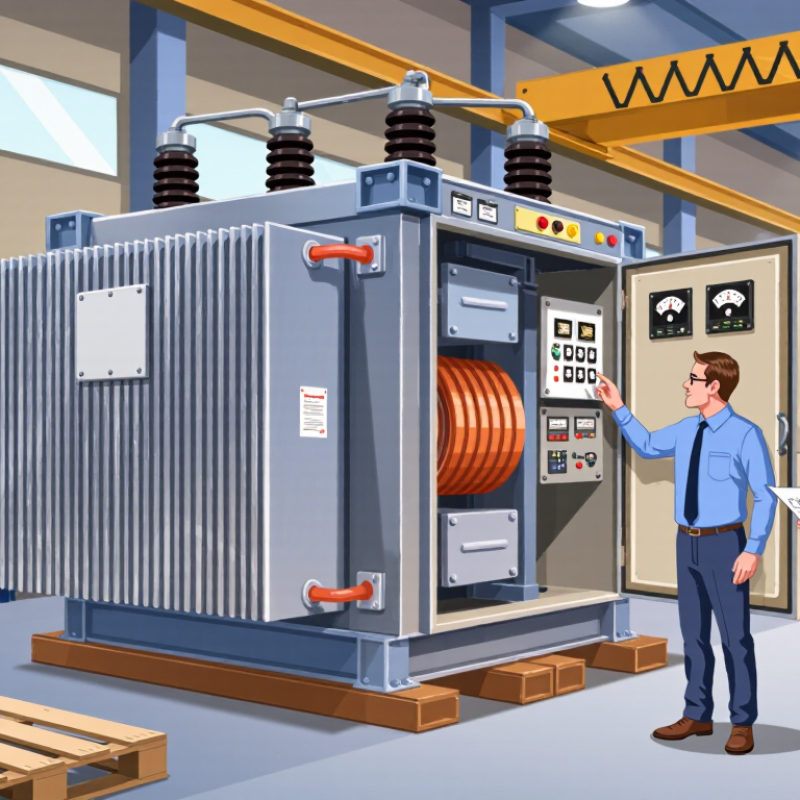
Before comparing suppliers, define the transformer’s job. A utility distribution transformer differs from a furnace, traction, dry-type, or solar step-up transformer. Record the primary and secondary voltage, frequency, phase count, vector group, impedance, insulation level, cooling method, and installation altitude. IEC 60076 provides the technical foundation, but the project environment decides the final specification.
Rating is more than a kVA or MVA number.
Estimate continuous load, motor starting current, harmonic distortion, renewable intermittency, and future expansion. A data center may require low-loss dry-type units and strong short-circuit performance. A rural substation may prioritize outdoor durability, oil containment, and easy maintenance. The IEA’s Electricity 2024 report forecasts global electricity demand to grow by an average 3.2% annually through 2026. That growth makes spare capacity valuable, but oversized equipment can increase purchase cost and no-load losses.
Application details often expose hidden risks.
Check ambient temperature, seismic conditions, corrosive dust, fire restrictions, grid fault levels, and transport limits. The IEA’s Electricity Grids and Secure Energy Transitions report says the world must add or replace over 80 million kilometers of grids by 2040. Procurement pressure will rise. A rushed specification may pass a factory test yet fail during repeated overloads. That possibility deserves attention. Review actual load profiles, not hopeful projections. A modest mistake here can affect efficiency, protection settings, service life, and compliance for decades.
Check Voltage, Frequency, Efficiency, and Load Compatibility
10 Transformer Buying Tips for Global Buyers
A transformer can look correct and still fail in service. Voltage is the first checkpoint: verify primary and secondary ratings, phase configuration, insulation level, and tap range. A 400 V, 50 Hz system is not automatically compatible with a 480 V, 60 Hz installation. Frequency affects core flux, heating, and noise. Always compare the nameplate with measured site conditions, not only the purchase order.
Tip: Request test reports for no-load loss, load loss, impedance, temperature rise, and sound level. The U.S. Department of Energy estimates that its 2024 distribution-transformer standards could save 3.6 quadrillion Btu over 30 years. Efficiency matters most when equipment operates continuously. Still, a high-efficiency unit may not suit a lightly loaded site if its purchase cost or physical size becomes excessive.
Load compatibility requires more than matching kVA. Check motor starting current, harmonic-producing equipment, unbalanced phases, ambient temperature, altitude, and future expansion. IEC 60076 testing principles provide a useful technical reference, but local grid rules may add requirements. Tip: Ask for a load profile covering 24 hours, including peak and standby periods. I have seen projects rely on an average load and miss short, damaging surges. That mistake is easy to repeat. Provide cable lengths and protection settings early; otherwise, a technically efficient transformer may still trip, overheat, or deliver unstable voltage.
Evaluate Safety Standards, Certifications, and Environmental Protection
A transformer purchase should begin with safety evidence, not a polished brochure. Check whether the unit was tested against applicable IEC 60076 requirements, including temperature rise, insulation, short-circuit withstand, and routine tests. Ask for signed test reports, calibration records, and the exact model number. Certifications must match the destination market. A certificate for components does not automatically certify the complete transformer.
Look closely at installation risks. The enclosure should suit the site’s dust, moisture, altitude, and fire conditions. For oil-filled units, inspect sealing points, pressure relief devices, oil specifications, and leak-control arrangements. For sensitive indoor locations, dry-type transformers may reduce liquid leakage risks, but they still require ventilation and thermal monitoring. Small details matter. Missing documents are warning signs.
Environmental performance also deserves measurable proof. The International Energy Agency reported in Electricity Grids and Secure Energy Transitions that annual grid investment must exceed 600 billion dollars by 2030. Efficient transformers can reduce losses across expanding networks. Request guaranteed no-load and load-loss values, tested at defined temperatures. Ask about recyclable materials, low-impact insulation, and responsible end-of-life handling. ISO 14001 may support a manufacturer’s environmental management system, but it does not prove every product is environmentally superior. That distinction is easy to miss. Buyers should also verify whether insulating fluids are PCB-free and whether spill containment fits local requirements. A certificate helps, but it cannot replace an independent inspection.