Leave Your Message

China Best Types Of Transformer for Global Buyers

Choosing the right Types Of Transformer is becoming a strategic decision for global buyers. Grid expansion, renewable projects, and industrial electrification are increasing demand for dependable voltage conversion. Grand View Research valued the global transformer market at approximately USD 67 billion in 2023. Its report also projects continued growth through 2030. Mordor Intelligence identifies renewable integration and grid modernization as major market drivers.

The choices are practical, not merely technical. Oil-immersed transformers suit high-capacity substations and outdoor installations. Dry-type transformers offer cleaner operation inside factories, hospitals, and commercial buildings. Distribution transformers support local networks, while power transformers manage transmission-level loads. A buyer must compare capacity, insulation class, cooling method, frequency, losses, noise, altitude, and maintenance access. Small details matter.

Transformer specialist Martin J. Heathcote, author of The J&P Transformer Book, states, “Transformer selection must begin with the application, not the catalogue.” That principle remains highly relevant. A low purchase price can become expensive through energy losses, overheating, or unavailable spare parts. The numbers deserve scrutiny.

For global buyers, supplier experience also matters. Factory testing, IEC compliance, traceable materials, and after-sales support can reveal operational reliability. Yet no single transformer type fits every project. Climate, grid stability, installation space, and local standards change the answer. Even widely used designs require careful verification. This guide examines the main Types Of Transformer and explains where each design performs best, where it struggles, and what buyers may overlook.

China Best Types Of Transformer for Global Buyers

What Makes China-Made Transformers Suitable for Global Buyers

China-made transformers are increasingly suitable for global buyers because manufacturers can combine large production capacity, flexible engineering, and competitive delivery schedules. The International Energy Agency’s Electricity Grids and Secure Energy Transitions report estimates that annual grid investment must exceed 600 billion US dollars by 2030. This growing demand makes reliable transformer sourcing increasingly important.

In practical procurement, suitability depends on more than price. Experienced buyers should request IEC 60076 test records, temperature-rise results, insulation data, and documented material traceability. Manufacturers serving export markets often support oil-immersed, dry-type, and low-loss transformer designs for different climates. They can also adjust voltage ratios, enclosure protection, cooling methods, and connection layouts. The U.S. Department of Energy’s 2024 distribution transformer analysis highlights the importance of reducing no-load and load losses across operating conditions. Small efficiency gains can become significant over decades.

Details matter.

A supplier may offer impressive factory photographs but weak inspection discipline. That risk deserves attention. Buyers should verify routine testing, independent inspection options, spare-part planning, and after-sales response before signing contracts. ISO-certified processes can improve consistency, but certification alone does not prove every unit performs equally. A better evaluation compares measured losses, acoustic levels, sealing quality, and delivery records. China’s manufacturing ecosystem is strong, yet global buyers should still review each project carefully rather than treating country of origin as a guarantee.

Main Transformer Types Manufactured in China

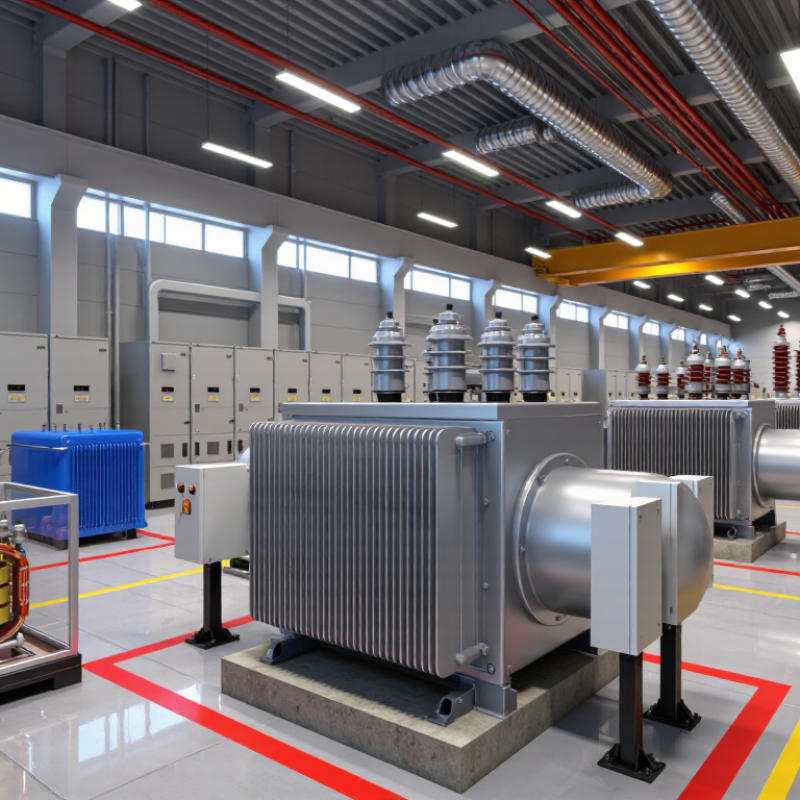
China manufactures several main transformer types for global buyers, each suited to different operating conditions. Oil-immersed power transformers support substations, factories, and utility networks where high capacity and efficient cooling matter. Mineral oil surrounds the windings and carries heat toward radiators. These units often serve medium- and high-voltage systems.

Dry-type transformers use air or solid insulation instead of liquid. Cast-resin designs are common in hospitals, commercial buildings, tunnels, and indoor industrial areas. They reduce leakage concerns and simplify installation in sensitive locations. Amorphous-alloy distribution transformers can lower no-load losses, especially where equipment remains energized for long periods. Box-type substations combine transformers, switchgear, and protection equipment in a compact enclosure.

Special applications need closer engineering review. Furnace transformers handle demanding industrial loads, while traction transformers support railway power systems. Buyers should check voltage ratio, frequency, vector group, impedance, cooling method, noise level, and loss values. Factory routine tests, temperature-rise results, insulation tests, and partial-discharge data provide useful evidence of manufacturing control. Independent inspection can reveal small problems before shipment.

A low price may look attractive. It can hide higher lifetime losses or weaker accessories. Some specifications also remain unclear between suppliers. Ask for drawings, test standards, material details, and maintenance requirements. Site altitude, humidity, salt exposure, and transport conditions should influence the final design. The cheapest transformer is not always the most reliable choice.

How to Match Transformer Types With Application Requirements

China Best Types Of Transformer for Global Buyers

How to Match Transformer Types With Application Requirements

Choosing a transformer should begin with the application, not the product name. A distribution transformer suits factories, buildings, and local power networks. A power transformer fits high-capacity transmission stations and large industrial systems. For sensitive equipment, an isolation transformer can reduce electrical noise and improve separation between circuits. Dry-type transformers work well indoors, especially where fire safety and low maintenance matter. Oil-immersed models often support higher capacities and outdoor installations, but they require suitable containment and inspection.

Match the transformer to voltage, frequency, load profile, ambient temperature, and installation space. A step-down unit may serve imported machinery, while a step-up unit can support long-distance power delivery. Check short-circuit strength, cooling method, efficiency, noise limits, and connection design. The first selection is rarely perfect. Real loads change, and an oversized transformer may waste money and energy. Ask for routine test reports, material details, applicable standards, and clear warranty terms. Independent technical review is still valuable.

Tips: Provide the supplier with actual input and output voltages, peak load, daily operating hours, indoor or outdoor conditions, and altitude. Mention harmonics from variable-speed drives or data equipment. Leave room for future expansion, but avoid exaggerated capacity. A practical comparison table helps. Also, confirm maintenance access before ordering; a compact installation can become inconvenient very quickly.

China Best Types of Transformer for Global Buyers

How to Match Transformer Types With Application Requirements

The chart shows representative engineering capacity ranges for commonly used transformer types. Control transformers suit low-power control circuits, isolation transformers support electrical separation, dry-type and oil-immersed distribution transformers serve commercial and industrial distribution systems, while power transformers are designed for high-capacity transmission and grid substations. Actual ratings depend on voltage, load profile, cooling method, installation conditions, and applicable standards.

Key Standards and Specifications for International Projects

China Best Types of Transformer for Global Buyers

Key Standards and Specifications for International Projects

International transformer selection should begin with the project standard, not the supplier catalogue. IEC 60076 covers power transformers, while IEEE C57.12.00 defines widely used requirements in North American projects. These systems are not identical. Confirm voltage, frequency, insulation level, vector group, impedance, tap range, and cooling method before comparing prices.

Small details matter.

For oil-immersed units, buyers should review temperature rise, short-circuit withstand, dielectric tests, oil preservation, and bushing ratings. Dry-type transformers require careful checks on fire performance, enclosure protection, ventilation, and partial discharge. IEC 60076-11 addresses dry-type designs. IEC 60076-3 and IEC 60076-5 support insulation and short-circuit verification. Factory test reports should show measured losses, ratio deviation, winding resistance, and impulse-test results.

Demand is becoming more critical. The International Energy Agency’s Electricity Grids and Secure Energy Transitions report estimates annual grid investment must rise to about USD 600 billion by 2030, nearly doubling current levels. This expansion increases pressure for reliable, efficient transformers. Buyers should also assess no-load and load losses, because efficiency affects operating cost for decades. A practical weakness remains common: project documents sometimes omit altitude, ambient temperature, seismic conditions, or harmonic loads. That omission can produce an unsuitable specification. Request type-test evidence, routine-test records, installation drawings, and local compliance documents before approval. No single standard fits every country. Specification alignment must be verified line by line.

China Best Types Of Transformer for Global Buyers - Key Standards and Specifications for International Projects
Transformer Type Typical Rating Range Typical Voltage Applications Cooling / Insulation Key Technical Characteristics Common International Standards Typical Global Applications International Project Selection Notes
Oil-Immersed Distribution Transformer Approximately 25 kVA to 5 MVA Medium-voltage primary systems, commonly 3.3 kV to 35 kV; low-voltage secondary systems commonly up to 1.1 kV ONAN Mineral oil or approved ester fluid High efficiency, reliable outdoor operation, natural liquid cooling, and suitable overload capability when correctly specified. Usually supplied with off-circuit or on-load tap changing according to system requirements. IEC 60076-1
IEC 60076-2
IEC 60076-3
IEEE C57.12.00
IEEE C57.12.20
Utility distribution networks, industrial substations, commercial facilities, renewable-energy collection systems, and rural electrification. Confirm system frequency, primary and secondary voltage, vector group, impedance, altitude, ambient temperature, installation location, and required energy-efficiency level.
Oil-Immersed Power Transformer Approximately 5 MVA to several hundred MVA High-voltage and extra-high-voltage transmission or grid-interconnection systems, typically above 35 kV ONAN ONAF OFAF Mineral oil or ester fluid Designed for high system voltage and large power transfer. May include radiators, conservators, Buchholz protection, online temperature monitoring, bushings, pressure-relief devices, and an on-load tap changer. IEC 60076 series
IEC 60076-7
IEC 60076-8
IEEE C57.12.00
IEEE C57.12.90
Transmission substations, power plants, large industrial plants, data-center grids, and interconnection points for utility-scale solar or wind projects. Project specifications should define short-circuit withstand, insulation levels, no-load and load losses, sound level, transport limits, seismic requirements, accessories, and factory test scope.
Cast-Resin Dry-Type Transformer Approximately 50 kVA to 20 MVA Low-voltage and medium-voltage systems, commonly up to 36 kV class AN AF Air-insulated, epoxy-resin encapsulated windings No liquid insulation, reduced fire and leakage risk, suitable for indoor installations, and generally low maintenance. Forced-air cooling can increase capacity where permitted by the design. IEC 60076-11
IEC 60076-1
IEC 60076-3
IEEE C57.12.01
IEEE C57.12.91
High-rise buildings, hospitals, shopping centers, airports, tunnels, offshore facilities, metro systems, and indoor industrial substations. Check fire classification, enclosure rating, ventilation, noise limits, partial-discharge performance, humidity conditions, altitude derating, and indoor clearance requirements.
VPI Dry-Type Transformer Approximately 100 kVA to 10 MVA Low-voltage and medium-voltage distribution and industrial systems, commonly up to 15 kV or 24 kV class AN AF Vacuum-pressure-impregnated insulation Air-cooled windings impregnated with insulating resin. Provides good mechanical strength and is often selected for industrial environments where liquid-free insulation is preferred. IEC 60076-11
IEC 60076-1
IEEE C57.12.01
Manufacturing plants, commercial buildings, infrastructure projects, motor-control systems, and indoor or sheltered substations. Compare temperature-rise limits, insulation class, impulse withstand level, enclosure protection, harmonic-current capability, and cooling-fan control philosophy.
Compact / Pad-Mounted Transformer Approximately 75 kVA to 5 MVA Medium-voltage distribution, commonly 2.4 kV to 35 kV primary and up to 1.1 kV secondary ONAN Sealed-tank or conservator-type liquid insulation Ground-level, enclosed construction with integrated medium-voltage switching or fusing options. Designed for outdoor distribution with accessible low-voltage connections. IEC 60076 series
IEEE C57.12.34
IEEE C57.12.28
IEEE C57.12.00
Residential developments, commercial parks, renewable-energy sites, campuses, and underground or urban distribution networks. Specify cabinet access, tamper resistance, corrosion protection, grounding arrangement, winding connection, sectionalizing equipment, and local utility requirements.
Autotransformer Approximately 1 MVA to several hundred MVA Systems with relatively close voltage ratios, such as transmission interconnections and large motor starting applications ONAN ONAF Oil-immersed or dry-type designs Uses a common winding portion for the primary and secondary circuits. It can reduce size, weight, and losses compared with a two-winding transformer when galvanic isolation is not required. IEC 60076-1
IEC 60076-3
IEC 60076-5
IEEE C57.12.00
IEEE C57.12.90
Grid voltage conversion, large motor starting, industrial power systems, and transmission substations with compatible voltage ratios. Do not select when electrical isolation is required. Carefully evaluate fault-current levels, neutral grounding, insulation coordination, and common-winding stress.
Three-Winding Transformer Approximately 10 MVA to 300 MVA or more High-voltage, medium-voltage, and auxiliary or tertiary voltage systems ONAN ONAF Oil-immersed construction Provides three electrically coordinated voltage levels in one tank. A tertiary winding may supply auxiliary loads, compensate harmonics, or support reactive-power equipment. IEC 60076-1
IEC 60076-3
IEC 60076-5
IEEE C57.12.00
IEEE C57.12.90
Power plants, transmission substations, industrial networks, railway traction systems, and renewable-energy collector substations. Define individual winding ratings, impedance matrix, tap-changer location, phase displacement, tertiary purpose, zero-sequence behavior, and short-circuit forces.
Furnace / Rectifier Transformer Approximately 1 MVA to more than 100 MVA Industrial medium-voltage or high-voltage supply to low-voltage, high-current rectifier or furnace equipment ONAN ONAF OFAF Oil-immersed, often with special cooling systems Built for high current, frequent load variation, harmonic loading, phase-shift arrangements, and severe thermal and mechanical duty. Connection design depends on the rectifier or furnace process. IEC 60076 series
IEC 61378-1
IEEE C57.18.10
Steel production, electric arc furnaces, electrolysis, large rectifier systems, chemical processing, and heavy industrial plants. Provide the load waveform, harmonic spectrum, duty cycle, short-circuit data, cooling-water conditions, harmonic derating requirements, and process-control interface.
Grounding Transformer Approximately 100 kVA to 30 MVA Medium-voltage and high-voltage networks requiring a neutral point or controlled zero-sequence path ONAN Oil-immersed or dry-type construction Creates an artificial neutral for grounding and may be combined with a neutral grounding resistor or reactor. Common configurations include zigzag and grounded-wye/delta arrangements. IEC 60076-1
IEC 60076-6
IEEE C57.32
IEEE C57.12.01 where applicable
Isolated networks, renewable-energy collector systems, industrial distribution networks, mining installations, and generator auxiliary systems. Specify zero-sequence impedance, neutral current, fault duration, grounding resistor or reactor data, insulation levels, and protection-coordination requirements.
Traction Transformer Approximately 5 MVA to 100 MVA Railway supply systems such as 15 kV or 25 kV AC traction networks, subject to the railway operator's requirements ONAN ONAF Oil-immersed or specialized dry-type construction Designed for repeated load cycles, voltage imbalance, harmonics, regenerative braking effects, and high mechanical or environmental stress. IEC 60076 series
IEC 61378-1
IEC 61378-3
EN 50329 where applicable
Railway substations, metro systems, high-speed rail, industrial railways, and electrified transport infrastructure. Confirm railway voltage, frequency, duty cycle, short-circuit duration, harmonic limits, seismic class, enclosure requirements, and compatibility with railway protection systems.
Converter / Renewable-Energy Transformer Approximately 1 MVA to 150 MVA Collector-system medium voltage to grid high voltage, commonly 11 kV to 35 kV on the converter side ONAN ONAF Oil-immersed or dry-type, depending on installation Engineered for converter-generated harmonics, rapid power changes, high availability, and specialized vector groups. May be integrated with solar, wind, battery, or STATCOM systems. IEC 60076 series
IEC 61378-1
IEC 60076-16 for wind-turbine applications
IEEE C57.12.00
Solar photovoltaic plants, wind farms, battery-energy-storage systems, grid-forming converters, and power-quality installations. Define harmonic spectrum, converter topology, maximum DC bias if applicable, ambient profile, overload cycle, grounding method, protection interface, and grid-code obligations.
Note: Rating ranges, voltage classes, cooling codes, and accessories are typical project-planning values. Final specifications should follow the applicable utility standards, national regulations, grid code, site conditions, and purchaser requirements.

How Global Buyers Can Compare Chinese Transformer Suppliers

China Best Types Of Transformer for Global Buyers

How Global Buyers Can Compare Chinese Transformer Suppliers

Comparing Chinese transformer suppliers requires more than checking the lowest quotation. Match the transformer type to the project: oil-immersed units suit substations, while dry-type transformers often fit commercial buildings and sensitive indoor sites. Specify voltage ratio, rated power, frequency, cooling method, impedance, insulation level, and tap-changer requirements. Small omissions create expensive revisions.

Use IEC 60076 as the technical baseline, then request routine and type-test evidence from an accredited laboratory. Check no-load loss, load loss, temperature rise, partial discharge, short-circuit strength, and acoustic performance. The International Energy Agency reported that annual global grid investment must exceed 600 billion dollars by 2030. Demand is rising, but quality cannot be compressed into a faster delivery promise.

A serious comparison also examines manufacturing depth. Ask for photographs of winding equipment, drying ovens, vacuum oil treatment, and final inspection records. Review at least three completed export projects with similar voltage and climate conditions. Confirm ISO 9001 processes, spare-parts support, warranty exclusions, packaging, and delivery terms. The U.S. Department of Energy’s 2024 Electric Grid Supply Chain Review highlighted continuing transformer supply pressures. A low price may hide longer lead times. I would still verify every certificate independently, because paperwork can look stronger than production reality.

Keep one point open for reflection: a supplier that answers quickly is not always the supplier that tests carefully.